Cryptonic Area · Blue Team / Defensive Security

Become the analyst who catches

The SOC Analyst Advanced Training & Certification Program — a fully live, 1 month, mentor-led course that takes you from the basics all the way to real SOC-floor skills: log analysis, SIEM, threat detection, incident response and the MITRE ATT&CK framework.

No pre-recorded playlists. Every session is live, every doubt is solved in real time, and you get direct 1:1 mentorship from a mentor who has real, hands-on industry experience — not a borrowed slide deck.

Limited seats — this batch is filling fast
100% Live Sessions 1:1 Mentorship Beginner Friendly Certificate Included
0 Month
Live Training
1:1
Mentorship
0%
Practical, Hands-On
Lifetime
Community Access
Blue Team, Explained

While Red Teams break in, SOC Analysts are the ones who catch them.

A Security Operations Center (SOC) is the nerve center of an organization's defense — the team that watches logs, alerts, and network traffic 24/7 to spot an attacker the moment they move. A SOC Analyst is the person sitting behind that screen: monitoring, investigating, and responding before damage is done.

Every company with a security team needs SOC Analysts — banks, product companies, MSSPs, government bodies, and startups alike. It is one of the most in-demand, beginner-accessible entry points into a long-term cyber security career.

Detection Investigation Response
blue-team@cryptonicarea:~
$ tail -f /var/log/auth.log
[ALERT] 47 failed logins from 185.220.x.x in 60s
$ splunk search "index=firewall action=blocked"
[+] Correlating with MITRE ATT&CK T1110 — Brute Force
$ wireshark -i eth0 -f "host 185.220.x.x"
[+] Incident ticket #INC-2291 created — escalated to L2
What Makes This Different

Built like an industry onboarding, not a course

Every element of this program is designed the way a real security team trains its own new analysts.

100% Live Sessions

No recorded playlists. Every class runs live, with real-time doubt solving.

1:1 Mentorship

Direct access to your mentor whenever you're stuck — you're never learning alone.

Real Simulated Labs

Practice on live-style SOC environments — real logs, real alerts, real incidents.

Certificate Included

A SOC Analyst Advanced Training Certificate from Cryptonic Area on completion.

Lifetime Community

Stay connected with mentors and fellow analysts long after the program ends.

Career-Ready Prep

Resume guidance, interview prep, and clarity on real SOC job roles and paths.

What You'll Learn

Everything a working SOC Analyst actually uses

From absolute fundamentals to real detection and response — nothing skipped.

Networking & cyber security fundamentals (TCP/IP, DNS, HTTP/S, OSI model)
  • How the OSI & TCP/IP models map to real network traffic you'll see in logs
  • DNS resolution walkthrough — how a domain lookup can reveal C2 or exfiltration
  • HTTP vs HTTPS — request/response anatomy, headers, and status codes analysts rely on
  • IP addressing, subnetting basics, and how to read a network diagram
  • Common ports & protocols every SOC analyst must recognize on sight
  • Hands-on: capturing and reading your first packet trace
SOC structure — L1 / L2 / L3 analyst roles & responsibilities
  • What an L1 analyst actually does on a typical shift
  • Escalation path — when and how L1 hands off to L2/L3
  • How a SOC team is organized (shift lead, analysts, threat hunters, IR team)
  • Ticketing workflow — from alert to closed incident
  • Key metrics SOC teams are measured on (MTTD, MTTR)
  • Hands-on: walking through a real SOC shift handover
Windows & Linux log sources — event IDs, syslogs, auth logs
  • Windows Event Viewer — key Event IDs analysts check daily (4624, 4625, 4688, etc.)
  • Linux syslog & auth.log structure and where to find them
  • Parsing logon/logoff, privilege use, and process creation events
  • Centralizing logs from multiple hosts into one place
  • Spotting log tampering or gaps — a red flag in itself
  • Hands-on: hunting for suspicious logons across a sample log set
SIEM fundamentals — Splunk & ELK Stack, dashboards, correlation rules
  • What a SIEM actually does and why every SOC runs one
  • Building your first Splunk search & dashboard
  • Setting up the ELK Stack (Elasticsearch, Logstash, Kibana) from scratch
  • Writing basic correlation rules to auto-flag suspicious patterns
  • Reading and interpreting a SIEM dashboard under pressure
  • Hands-on: building a working detection rule in a live SIEM lab
Alert triage — separating true positives from noise
  • Why most SIEM alerts are noise — and how to tell which ones matter
  • A repeatable triage checklist used by real SOC teams
  • Prioritizing alerts by severity and business impact
  • Avoiding alert fatigue without missing real threats
  • Documenting your triage decision so L2 can pick it up instantly
  • Hands-on: triaging a queue of live-style alerts against the clock
Network security monitoring with Wireshark & packet analysis
  • Capturing live traffic and filtering out the noise
  • Spotting suspicious patterns — port scans, beaconing, data exfiltration
  • Following a TCP stream to reconstruct an attacker's actions
  • Identifying malicious payloads inside packet captures
  • Correlating packet-level evidence with SIEM alerts
  • Hands-on: analyzing a real attack pcap file
IDS / IPS — Snort & Suricata rule basics
  • Difference between an IDS and an IPS, and where each fits in the network
  • Reading and understanding a basic Snort/Suricata rule
  • Writing a simple custom detection rule
  • Tuning rules to reduce false positives
  • How IDS/IPS alerts feed into your SIEM
  • Hands-on: deploying a rule and triggering it in a lab
Threat intelligence & Indicators of Compromise (IOCs)
  • What counts as an Indicator of Compromise (IP, hash, domain, pattern)
  • Where to source reliable threat intel (feeds, OSINT, vendor reports)
  • Enriching an alert with threat intel before escalating it
  • Using IOCs proactively to hunt, not just react
  • Documenting IOCs so the whole team benefits
  • Hands-on: enriching a real alert with live threat intel lookups
MITRE ATT&CK framework — mapping real attacker tactics & techniques
  • What MITRE ATT&CK is and why every modern SOC uses it
  • Mapping a real incident to specific tactics & techniques
  • Using ATT&CK to identify gaps in your detection coverage
  • Reading an ATT&CK Navigator heatmap
  • How attackers chain techniques into a full kill chain
  • Hands-on: mapping a simulated intrusion end-to-end on ATT&CK
Phishing & email header investigation
  • Anatomy of a phishing email — what to check first
  • Reading email headers to trace the real sender
  • Spotting spoofed domains, lookalikes, and malicious links
  • Analyzing attachments safely without detonating malware
  • Writing up a phishing investigation report
  • Hands-on: investigating a batch of real-style phishing samples
Endpoint Detection & Response (EDR) fundamentals
  • What an EDR agent monitors on an endpoint
  • Reading process trees to spot malicious execution chains
  • Isolating a compromised endpoint from an EDR console
  • Differentiating EDR alerts from antivirus alerts
  • Using EDR telemetry to support an investigation
  • Hands-on: investigating a simulated endpoint compromise
Malware analysis basics — static & behavioral indicators
  • Static vs behavioral analysis — what each tells you
  • Safely handling a suspicious file (sandboxing basics)
  • Reading basic file indicators (hashes, strings, metadata)
  • Recognizing common malware behavior patterns
  • When to escalate to a dedicated malware analyst
  • Hands-on: analyzing a sample in a safe sandbox environment
Incident Response lifecycle — detection, containment, eradication, recovery
  • The 6-phase IR lifecycle: prep, detection, containment, eradication, recovery, lessons learned
  • Your role as an analyst at each phase
  • Writing a clear, timestamped incident timeline
  • Communicating status during an active incident
  • Post-incident review — what actually improves a SOC over time
  • Hands-on: running through a full IR lifecycle on a simulated incident
Vulnerability management basics & patch prioritization
  • Reading a vulnerability scan report (CVSS scores explained)
  • Prioritizing patches by real-world exploitability, not just severity score
  • How vulnerability management connects to what SOC analysts see in alerts
  • Working with IT/patch teams as a security analyst
  • Tracking remediation through to closure
  • Hands-on: prioritizing findings from a sample vulnerability report
SOC reporting, playbooks & runbook documentation
  • What makes an incident report genuinely useful to the next shift
  • Structuring a playbook so anyone on the team can follow it
  • Writing runbooks for common alert types
  • Communicating findings clearly to non-technical stakeholders
  • Keeping documentation current as threats evolve
  • Hands-on: writing your own playbook for a common alert scenario
Live-lab simulated attack-and-detect scenarios (capstone)
  • A live, simulated attack runs against a lab environment in real time
  • You detect, triage, investigate, and respond exactly like a real shift
  • Every step is reviewed by your mentor with direct feedback
  • Combines everything from the earlier weeks into one real scenario
  • Mistakes here are learning moments, not real-world consequences
  • This capstone is exactly what you'll describe in job interviews
Resume building, SOC interview prep & mock interview session
  • Rewriting your resume specifically for SOC Analyst roles
  • Turning your capstone project into strong interview stories
  • Common SOC interview questions and how to structure your answers
  • A live mock interview with real, direct feedback
  • LinkedIn profile review to attract recruiter attention
  • Building confidence for technical screening rounds
Career roadmap — how to move from L1 to L2/L3 and beyond
  • What separates an L1 analyst from L2/L3 in skill and responsibility
  • Certifications worth pursuing after this program (and which to skip early on)
  • Specialization paths — threat hunting, IR, detection engineering, threat intel
  • A realistic timeline for career progression in the industry
  • Building a portfolio that keeps growing after the program ends
  • Staying current in a field that changes every month
Honest Comparison

Why not just learn this from free YouTube videos?

You can — it'll just take you a lot longer, with no one checking your work. Here's the honest difference.

What You Get Free YouTube Videos Generic Recorded Course Cryptonic Area SOC Program
Structured, end-to-end curriculum
100% live sessions, not recordings
Real-time doubt solving
1:1 personal mentorship
Live-lab capstone with mentor review
Verifiable certificate on completion
Resume & mock interview prep

Free content can teach concepts. It can't check your work, answer your doubts live, or vouch for your skill.

Program Structure

Four weeks. One clear path from beginner to job-ready.

WEEK 01 01

Foundations

Networking basics, security fundamentals, Windows/Linux logs, and how a real SOC is structured.

WEEK 02 02

Monitoring & Detection

SIEM (Splunk/ELK), log correlation, network monitoring, IDS/IPS, and alert triage practice.

WEEK 03 03

Investigation & Response

MITRE ATT&CK mapping, phishing analysis, malware basics, and the full incident response lifecycle.

WEEK 04 04

Capstone & Career Prep

Live-lab simulated incident, SOC reporting, resume review, mock interview & certification.

Tools You'll Work With

Real, industry-standard SOC tooling

Splunk ELK Stack SIEM Platforms Wireshark Snort / Suricata (IDS/IPS) MITRE ATT&CK TheHive / Ticketing EDR Consoles Email Header Analysis
On Completion

An industry-level certificate that actually holds weight

Every analyst who completes the program is awarded the Cryptonic Area SOC Analyst Advanced Training Certificate — designed to reflect real, demonstrable skill, not just attendance.
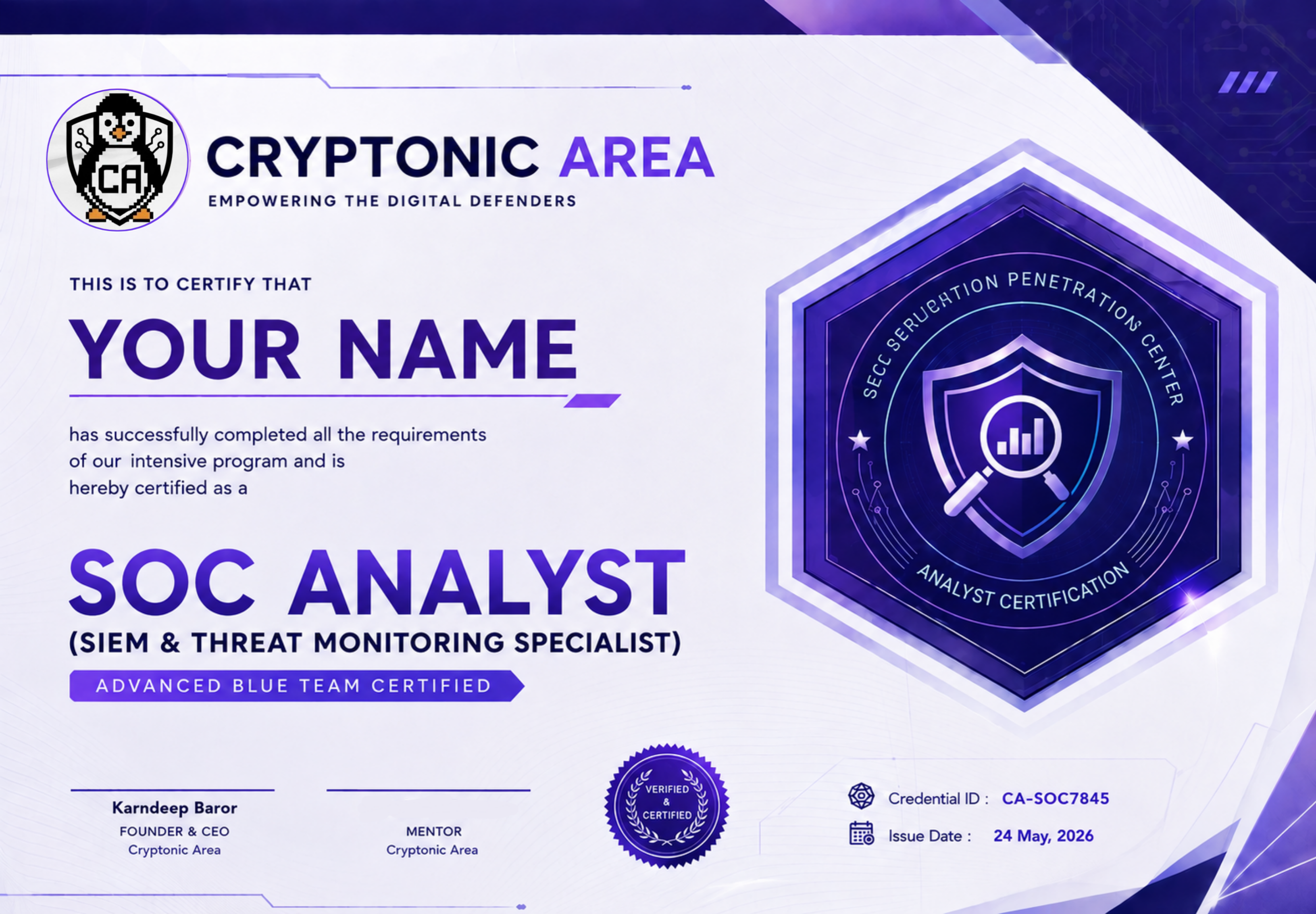
Cryptonic Area SOC Analyst Advanced Training & Certification Program certificate
Actual certificate awarded on successful completion.

Built for your resume & LinkedIn

A credential you can add directly to your resume, LinkedIn profile, and job applications as proof of practical SOC training.

Verifiable & unique

Each certificate carries a unique ID, so recruiters and employers can verify it belongs to you and was genuinely earned.

Backed by real, hands-on training

This isn't a certificate for attendance — it's awarded only after completing live labs, the capstone simulation, and the full curriculum.

Industry-level presentation

Professionally designed to be shown confidently to interviewers, HR teams, and hiring managers alike.

Who This Program Is For

Complete beginner? You're exactly who this was built for.

You don't need a computer science degree or prior security experience. If you can use a computer and are willing to show up and put in the work for one month, the program starts from zero and builds you up, step by step, to real SOC-floor skills.

Students & freshers wanting a real cyber security career start
IT professionals looking to move into security
Anyone who has tried tutorials before but wants real, live mentorship
Complete beginners — no prior cyber security background needed
Where This Can Take You

SOC Analyst is one of the highest-demand entry roles in cyber security

Indicative industry roles you can target after completing this program:

SOC Analyst (L1)

Entry-level monitoring & triage role

Threat Detection Analyst

Deeper investigation & detection engineering path

Incident Response Analyst

Long-term growth path into IR & threat hunting

Salary and role outcomes vary by company, city, and individual performance in interviews — this program builds the skill foundation employers look for in an entry-level SOC Analyst, it does not guarantee a job or a specific salary.

Led By An Industry Professional

Trained by a mentor with real, hands-on security experience

This program isn't taught from a script. Your mentor has real industry experience working with security tooling and live environments, and brings that practical, on-the-job perspective into every live session — so what you learn is what actually happens in a real SOC, not just theory.

Class Schedule & Mentor Access

3 Focused Hours, Every Evening — Taught Live By Your Mentor

No long, boring, pre-recorded playlists. Every single day, in a fixed 3-hour evening window, your mentor teaches you practically — live, hands-on, and interactive — so you can ask doubts in real time and get direct answers, straight from someone who has actually worked in the field.

class_schedule.log
$ whoami --batch
→ SOC Analyst Live Batch // Evening Session
-----------------------------------------
Duration : 3 Hours, Daily
Slot     : Evening Batch
Mode     : 100% Live, 100% Practical
Mentor   : Direct Interaction Enabled
Status   : Seats Filling Fast
Daily Duration
3 Hours / Day
Class Slot
Evening Batch

Taught Practically, Not Just Theoretically

Every evening class is hands-on — your mentor walks you through real tools, real logs and real attack scenarios live, not just slides.

Direct Mentor Interaction

You can interact with your mentor directly, ask doubts live during class and get them cleared on the spot — no waiting, no ignored messages.

Student Reviews

What students say after the program

Real feedback from students who went through the SOC Analyst training.

AS
Aditya Sharma 🇮🇳
Final Year Student

I had zero background in security. The live sessions and 1:1 doubt support made SIEM and log analysis actually click for me.

RK
Riya Kapoor 🇮🇳
Career Switcher

Switched from a non-tech role. The mentor explained MITRE ATT&CK and incident response in a way that finally made sense.

MZ
Mohammed Zaid 🇦🇪
Job Seeking

The live labs felt like an actual SOC floor. Walked into interviews able to explain real alert triage, not just theory.

PN
Priya Nair 🇮🇳
IT Professional

Already worked in IT support, wanted to move into security. This program gave me a clear, structured path into SOC work.

SI
Sana Iqbal 🇬🇧
Career Switcher

The capstone live-lab incident simulation was the highlight — genuinely felt like solving a real case, not a classroom exercise.

DP
Deepak Patel 🇮🇳
Final Year Student

Best part was the mentor being available for doubts even outside class hours. Never felt stuck for long.

NT
Nabin Thapa 🇳🇵
Job Seeking

Coming from a non-CS background, I was worried I'd fall behind. The pace and mentorship made sure I didn't.

KV
Kavya Verma 🇮🇳
Career Switcher

Worth every rupee. The certificate plus the hands-on labs gave me something concrete to show in interviews.

Before You Enroll

Exactly what you're signing up for — no surprises

100% Online
Format
Fully Live
Mode
Small Batch
Group Size
Zero to Job-Ready
Starting Point
Secure Checkout Mentor Led, Not AI-Generated Doubts Solved Till You Get It Certificate on Completion Direct Mentor Access
Program Fee

One price. Everything included.

Seats Filling Fast
SOC Analyst · Advanced Training & Certification
₹5,999 ₹12,000
One-time payment · Full 1 month program
100% live, mentor-led sessions
1:1 mentorship & doubt support
Real SIEM & SOC tool labs
MITRE ATT&CK & incident response training
Resume & mock interview preparation
Certificate of completion
Lifetime community access
Beginner friendly — starts from zero
Enroll Now — Secure Your Seat
Enroll and get started your career in — cyber security & ethical hacking
Common Questions

Frequently Asked Questions

Do I need prior experience to join?

No. The program starts with networking and security fundamentals before moving into SOC tools, so complete beginners are welcome.

Is this live or pre-recorded?

Every session is delivered 100% live by a mentor, with real-time doubt solving and 1:1 mentorship throughout the program.

How long is the program?

It's a focused, intensive one-month program covering fundamentals through to a live-lab capstone and career prep.

Will I get a certificate?

Yes — every student who completes the program receives a SOC Analyst Advanced Training Certificate from Cryptonic Area.

What happens after the program ends?

You keep lifetime access to the Cryptonic Area community, so you can keep learning and stay connected with mentors and fellow analysts.

Refund Policy

At Cryptonic Area, we're committed to providing high-quality SOC training. Due to the nature of our digital products and the limited seating in our live cohorts, we maintain a strict policy regarding refunds.

No Refund Policy

All sales are final. Once enrollment is confirmed and access to the learning portal/live sessions is granted, no refunds will be issued.

Why this policy?

Seat reservation: Our live batches are capped at 45 students. Enrolling takes a seat that cannot be filled by another student once the batch begins.
Digital assets: You receive immediate access to proprietary course materials, labs, and intellectual property upon registration.
Server costs: We incur immediate server and infrastructure costs to provision your dedicated lab environment.

* Exceptions may be made in cases of duplicate payment due to a technical error. Please contact training@cryptonicarea.site within 48 hours of the transaction.

Cryptonic Area · SOC Analyst Program

Every SOC team needs an analyst who actually knows what they're looking at.

One month from now, you could still be watching tutorials — or you could be the one explaining, with confidence, exactly how you traced an alert back to a real threat. Seats for this batch are limited.

Enroll Now — ₹5,999 Only